Curriculum / Collection — The Business of Art
Group Details:
NYDIA
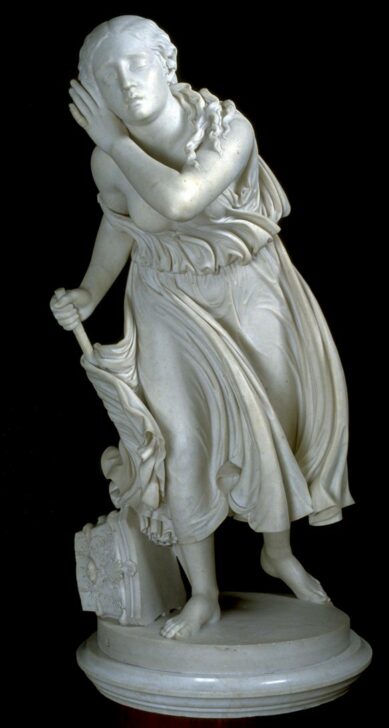
One of the first major additions to the collection, Randolph Roger’s Nydia, the Blind Flower Girl of Pompeii was acquired in 1860. This work reflects the era’s significant cultural and educational emphasis on the classics. The sculpture was so popular in the nineteenth century that Rogers reproduced it 167 times. Traces of its function as a teaching object are still visible: look for the square hole at the base, where a wooden peg once allowed instructors to spin the sculpture so students could view it from every angle.
HUNGER. NO. 4
Acquisitioned in 1949, Max Beckmann’s Hunger. No. 4, is part of a large body of German expressionist work in the collection. In the 1930s and 40s, the Nazi regime seized and censored many artworks deemed “degenerate”. Following the end of WWII, many of these works entered the public art market. UMMA purchased many of these works, seeking to build a collection which spoke to recent history and issues of the current moment.
THIS BEGINNING OF MIRACLES
Corita’s This Beginning of Miracles was acquired during the directorship of Jean Paul Slusser (1946–1956). Slusser led a large shift toward contemporary art at UMMA and began acquiring works created just years, or even months, before they were shown on campus. These works were hung on a newly installed unistrut system as the historic apse was stretched to house this new body of work.
LA SOCIÉTÉ DE MÉTAYAGE
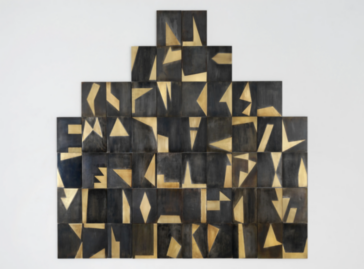
The most recent acquisition is La Société de Métayage (2021–22) by Moroccan artist M’barek Bouhchichi. This wall sculpture comprises fifty-four metal rectangles, each representing a plot of land. A fifth of each rectangle is cut out and overlaid with yellow brass, symbolizing the historical sharecropping system in southern Morocco, where Black communities, notably the Haratin, were permitted to farm land but retained only a fraction of the yield. The uniformity of the rectangles contrasts with the varied brass shapes, reflecting how systemic oppression can elicit diverse forms of resistance and adaptation. It is the first work by a contemporary North African artist to enter UMMA’s collection and reflects the museum’s current emphasis on contemporary works that bridge collecting areas and narratives.