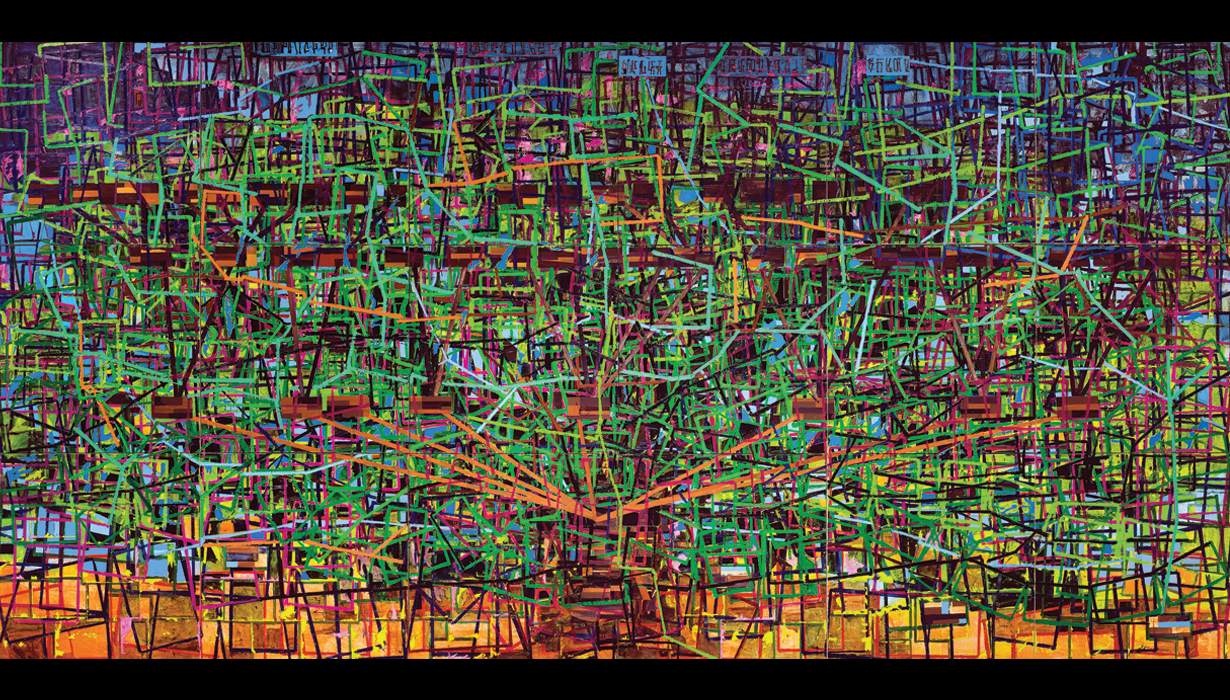
Black Wall Street Journey: Re and De Imagining Black Progress
Marking Rick Lowe’s largest institutional solo exhibition in the United States, Black Wall Street Journey is a public art project by the artist (Russell County, Alabama, 1961) that brings together painting, sculpture, and public installation to examine how Black prosperity, resilience, and self-determination are represented, measured, and understood.
Inspired by the rebuilding of Tulsa’s Greenwood neighborhood following the 1921 Tulsa Massacre, Lowe started Black Wall Street Journey in 2018 and has since produced numerous public art presentations, installations, research, and other projects. At UMMA, Re and De Imagining Black Progress includes new paintings, sculpture, and public installations that turn eight years of research into bold visual form.
The exhibition is the culmination of Lowe’s three-year residency at U-M’s Institute for Social Research (ISR), initiated by ISR Director Kathleen Cagney, and reflects deep engagement with researchers, data scientists and dozens of students. Through collaboration, and working across art, data, and inquiry, Lowe examines the forces that shape Black wealth and opportunity, including income and education to housing and business ownership.
A central element of this installation is the Black Wall Street Journey Ticker, installed on UMMA’s rooftop and in ISR’s Atrium on U-M’s Central Campus. The 40-ft-long LED panel recalls historic stock tickers, invented in 1867 to consolidate control of and access to financial information—they are still in use today. Lowe’s BWSJ Ticker displays information collected by the Panel Study on Income Dynamics and the Anti-Black Index, two ongoing research efforts generated by U-M faculty.
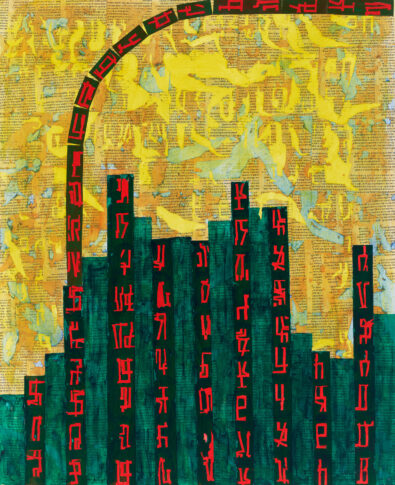
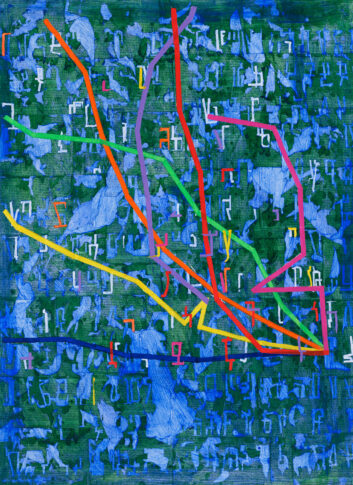
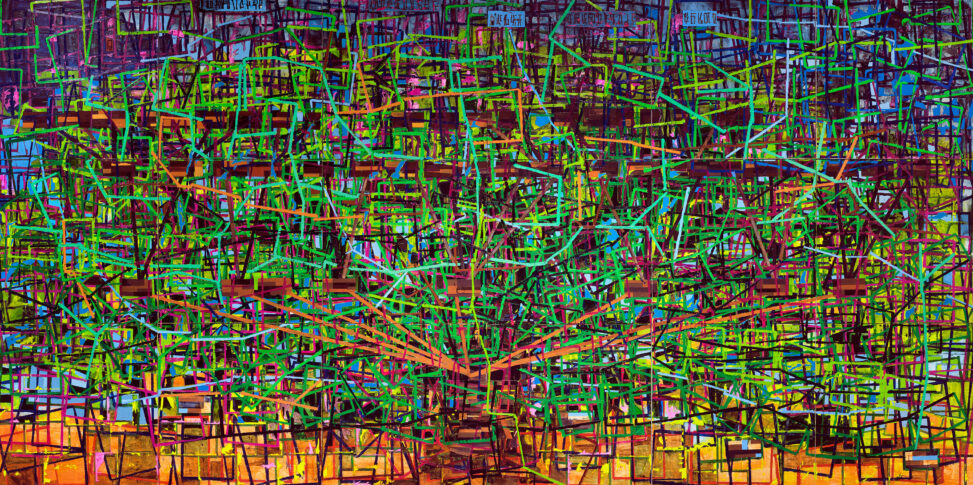
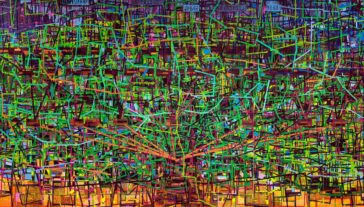
In UMMA’s Taubman gallery, more than twenty new works by Lowe converge civic research and civic imagination.
By showcasing these local and national trends, Black Wall Street Journey aims to become a campus-wide platform for assessing, understanding, and influencing the trajectory of Black well-being.
Select Images
Related Events
Collaborators
- Kathleen Cagney, Director of the Institute for Social Research
- Dr. Christian Davenport, Mary Ann and Charles R. Walgreen, Jr., Professor for the Study of Human Understanding, Professor of Political Science
- Nicole Marroquin, Professor of Art and Design, Penny W Stamps School of Art and Design
- Panel Study of Income Dynamics at the Institute for Social Research: Director Thomas Crossley, Assistant Director Noura Insolera, and Research Associate Malak Kalasho
SUPPORT
Lead support for this exhibition is provided by U-M Institute for Social Research, U-M Arts Initiative, Joseph and Annette Allen, the Terra Foundation for American Art, U-M Office of the Provost, and U-M Office of the President. Additional generous support is provided by Michigan Ross and U-M School of Social Work.