Female Figure
Description
Subject Matter:
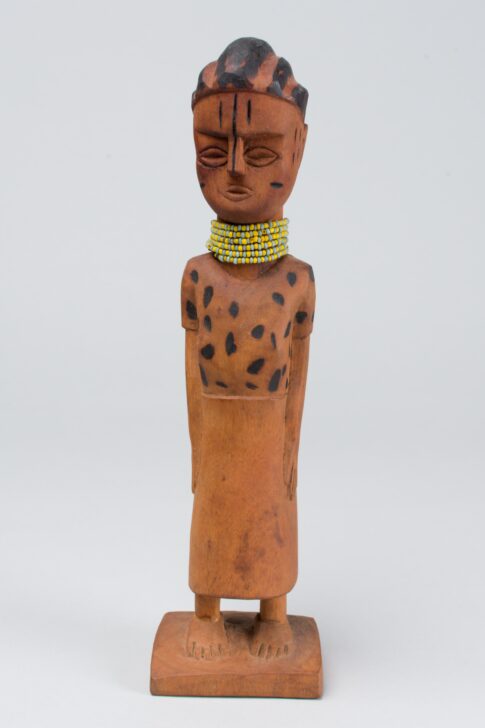
This figure was created in the 1970s by a Tabwa artist (name unrecorded), living near the town of Moba in the Democratic Republic of Congo. According to art historian Allen F. Roberts, who purchased it in Mpala Lubanda, DRC, in 1976, this figure is believed to be an nkisi which would have been placed in lineage shrines. A nkisi figure (minkisi plural form) is a medicine and spiritual figure. These are spiritual containers that are activated by healers to heal illness and protect against harm in some cases. At the time the work was collected, many of these practices were secretive because of persecution by local Catholic missionaries. This specific female figure is made of wood and glass beads, including various engravings on the wood that can be understood as body modification.
Sources:
Illustrated in The Rising of a New Moon: A Century of Tabwa Art (1986), p. 243.
“Nkisi Figures of the Lower Congo”, Zdenka Volavkova, African Arts , Winter, 1972, Vol. 5, No. 2 (Winter, 1972), pp. 52-59+84, https://www.jstor.org/stable/3334675.
“Duality in Tabwa Art”, Allen F. Roberts, African Arts , Aug., 1986, Vol. 19, No. 4 (Aug., 1986), pp. 26-35+86-87, https://www.jstor.org/stable/3336284.
“Genesis: Ideas of Origin in African Sculpture”, Alisa Lagamma, African Arts , Autumn, 2002, Vol. 35, No. 3 (Autumn, 2002), pp. 54-75+92, https://www.jstor.org/stable/3337863.
Peek, Philip M. Twins in African and Diaspora Cultures: Double Trouble, Twice Blessed. Bloomington: Indiana University Press, 2011. https://muse.jhu.edu/book/12785, chapter 11 by Allen Roberts, “Embodied Dilemma: Tabwa Twinship in Thought and Performance”
Physical Description:
Female figure with a long skirt and a beaded necklace. Her face is painted and her hair is braided.
Usage Rights:
If you are interested in using an image for a publication, please visit https://umma.umich.edu/request-image/ for more information and to fill out the online Image Rights and Reproductions Request Form.