Headrest
Kenyan
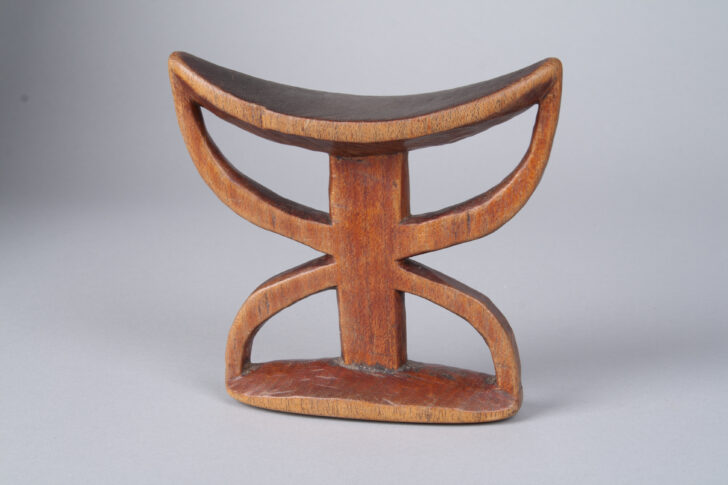
Description
Subject Matter:
Headrests, which support their owner’s head and coiffure during sleep, have been used on the African continent for thousands of years. Carved in a variety of shapes, and made out of wood, ceramic, or stone, the complexity of their designs correlates to their owner’s prestige. The headrests presented here were collected in ancient Egypt and twentieth-century Kenya and Somalia. Their remarkably similar design features attest to cultural and creative paths of exchange that have crisscrossed the continent for centuries.
Despite these continuities, it is rare for Egyptian art to be displayed alongside African art in museums. Sometimes Egyptian galleries will abut African galleries, but more often than not, Egyptian art is grouped with ancient Roman and Greek art in an entirely different part of the museum. This separation of Egypt from the rest of Africa is another example of how racist beliefs popularized at the time of colonization continue to structure and plague museum collections. During the Transatlantic Slave Trade, European nations cast the African continent and its peoples as inferior in order to justify their inhuman practices. But Egypt’s history as a major influence on Greece, considered the cradle of democracy and Western civilization, sat uneasily in this story—Africa could not be portrayed as barbaric and uncivilized if it gave birth to one of the world’s most admired civilizations. A stark line was thus drawn between Egypt and the rest of Sub-Saharan Africa, with little acknowledgement of influences or interactions.
Physical Description:
With curing openwork support forms.
Usage Rights:
If you are interested in using an image for a publication, please visit https://umma.umich.edu/request-image/ for more information and to fill out the online Image Rights and Reproductions Request Form.