Mouse Oracle Pot with lid (gbekre-sè)
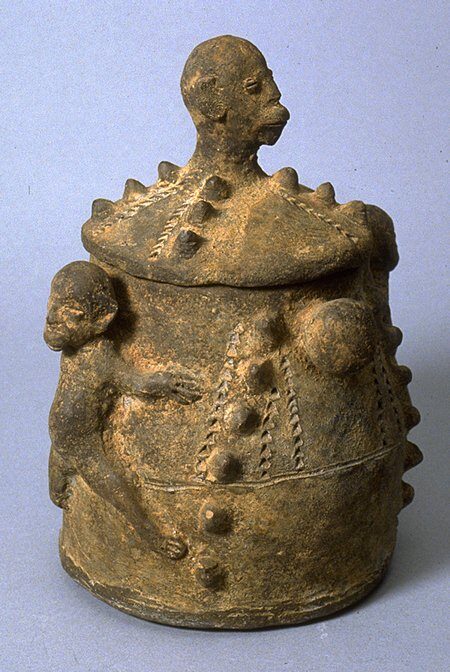
Description
This lidded vessel is a gbekre-sè (or “mouse oracle”) that would have been used by a Baulé diviner. A diviner's gourd or basket contains an assortment of natural and sculpted objects that are shaken or cast. The positions of the objects relative to each other are "read" by the practitioner. In the case of this type of divination vessel, a mouse is closed up in the pot and, in its scrambling about, rearranges twigs or other tiny objects into a configuration to be interpreted by the diviner. The figures represented on the exterior of the pot are reminiscent of baboons — baboon or other simian imagery is often incorporated into Baulé divination tools in reference to the animal’s tendency for trickery as well as power, much like the spirits with whom the diviner interacts.
Subject Matter:
This lidded vessel is a gbekre-sè (or “mouse oracle”) that would have been used by a Baule diviner. A diviner's gourd or basket contains an assortment of natural and sculpted objects that are shaken or cast. The positions of the objects relative to each other are "read" by the practitioner. In the case of this type of divination vessel, a mouse is closed up in the pot and, in its scrambling about, rearranges twigs or other tiny objects into a configuration to be interpreted by the diviner. The figures represented on the exterior of the pot are reminiscent of baboons — baboons or other simian imagery is often incorporated into Baulé divination tools in reference to the animal’s tendency for trickery as well as its power, much like the spirits with whom the diviner interacts.
This vessel is made of two distinct parts, or chambers, that are connected by a shelf with a small hole in it. There is a belief among the Baule people that in the past mice could speak—their natural proximity to earth’s surface and their ability to burrow allowed mice the ability to gain access to earth spirits (asye usu) and ancestors. When a mouse divination service takes place, the mouse is placed in the lower chamber. In the upper chamber, the diviner places 10 small sticks that are coated with flour. These small sticks are called ghekre nyma which means “eyes of the mice.” The mouse then moves through the hole into the upper chamber and rearranges the sticks, trying to eat the flour off the sticks. This configuration of the sticks is read by the diviner, often in response to the question they asked of the divination at the beginning of the session. It takes several years for the diviners to master this practice.
References:
LaGamma, Alisa, John Pemberton, and Metropolitan Museum of Art (New York, N.Y.). 2000. Art and Oracle : African Art and Rituals of Divination. New York: Metropolitan Museum of Art.
Physical Description:
A ceramic vessel in two parts. The bottom of the vessel consists of a hollowed base, which has a hole in the bottom, exposing its false bottom. The decoration on the outside includes two anthromorphic figures whose limbs are stretched along the outside of the base. They are decorated with 6 elevated dots on either side.
The lid of the vessel includes 4 times 3 dots radiating from the central anthropomorphic head.
Usage Rights:
If you are interested in using an image for a publication, please visit https://umma.umich.edu/request-image/ for more information and to fill out the online Image Rights and Reproductions Request Form.