Pot
Description
Subject Matter:
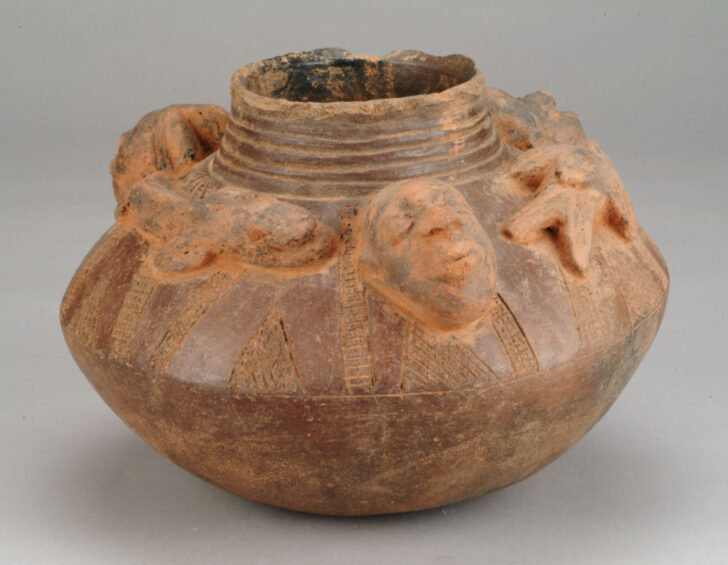
Yoruba-speaking peoples have a long history of ceramic arts, as terracotta figures from the city of Ife and surrounding areas date back to the 11th century and earlier. While vessels were sometimes created for use in shrines dedicated to various orisas (gods), pottery was also created for practical purposes. Large pots were used to store palm oil, while decanters held palm wine. In the area of Ogbomoso, brides sometimes stored their trousseaus in large wedding pots. The fish on this object may be mudfish, a symbol of Olokun, a deity of the sea that was popular among the Owo and Ijebu Yoruba kingdoms.
This pot was created in two parts. To start the pot, a lump of clay is thrown into a bed of ashes on the ground where the artist places their heel in the center and uses a circular motion to press the clay outward. This forms a disk about 2.5 cm thick and the size of a dinner plate. This is then thrown over a mold that is dusted with ashes as well to prevent sticking. This clay is beaten over the mold with a stone until it is about 1 cm thick. After drying, the clay is then made to be wet and scraped down to about a ½ cm thickness. The upper half of the pot is made with the coiling technique, joining a 5 cm thick coil to the lower half. To shape and smooth the rim, the potter uses wet leaves or rags and walks around the pot. The piece is then fired and finished.
References Cited:
Beier, Georgina. 1980. "Yoruba Pottery." African Arts, Vol. 13, No. 3: pp. 48-53;92.
Drewal, Henry John. 2008. "Mami Wata: Arts for Water Spirits in Africa and Its Diasporas." African Arts, Vol. 41, No. 2: pp. 60-83.
Physical Description:
A short, round clay vessel, wide at the middle while narrowing toward the top and bottom. The top half of the vessel is decorated with 3 alternating human faces and 3 fish, perhaps mudfish. There are also alternating columns and triangles around the top half, each decorated with various patterns of lines. The neck of the vessel is decorated with horizontal grooves.
Usage Rights:
If you are interested in using an image for a publication, please visit https://umma.umich.edu/request-image/ for more information and to fill out the online Image Rights and Reproductions Request Form.