Staff
African
Description
Subject Matter:
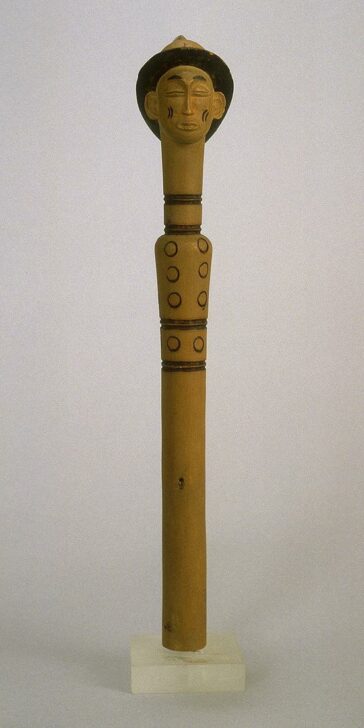
Historically, scepters, staffs, and wands were used to signal authority among numerous communities across the African continent. Often intricately decorated with beads, or expertly carved from ivory or precious woods, staffs were carried by persons in positions of authority, who used them to underline speeches, negotiate deals, and either threaten or reward members of their communities.
In the nineteenth and twentieth centuries, a recurring motif atop such staffs, like the one on the right, was an individual dressed in European clothing. In countries such as Nigeria and the Democratic Republic of the Congo, pith helmets, military uniforms, and bowler hats had become directly associated with colonial power and were used to represent Europeans. But local chiefs often adopted these pieces of clothing as well—at times to show their allegiance, and at other times to appropriate the symbolic imagery of their occupiers for their own purposes. Similar staffs, such as the one to the left, were also made for purchase by foreign visitors, who were entertained by the way their likenesses were captured.
Works like these that showcase cultural exchange with Europe were often rejected by museums in the Global North because they were not considered “authentically” African. This practice highlights the problematic notion of a “pure,” untainted African art—one that exists only in the Western imagination.
Usage Rights:
If you are interested in using an image for a publication, please visit https://umma.umich.edu/request-image/ for more information and to fill out the online Image Rights and Reproductions Request Form.